
Global Council for Tolerance and Peace Stresses the Need to Safeguard Regional Stability and Uphold International Law from Istanbul
Istanbul – April 17, 2026
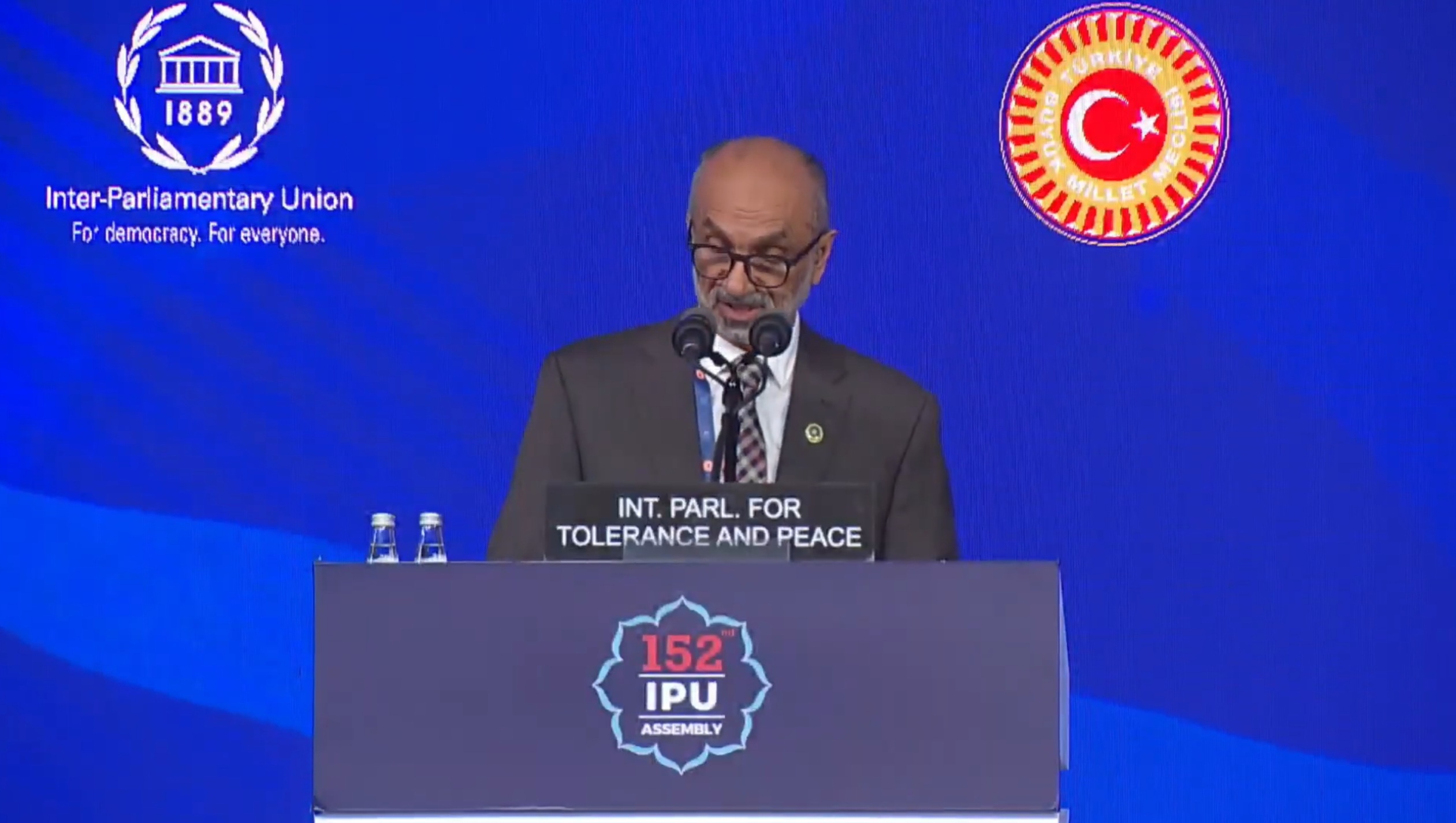
H.E. Ahmed bin Mohamed Aljarwan, President of the Global Council for Tolerance and Peace, participated in the 152nd Assembly of the Inter-Parliamentary Union (IPU), held in Istanbul, where he delivered a keynote address emphasizing the importance of strengthening international law and enhancing joint parliamentary action to confront the growing challenges threatening regional and global stability.
Aljarwan underscored that the current phase demands responsible positions grounded in dialogue and cooperation rather than escalation. He noted that peace does not arise automatically but is a deliberate political and legal choice rooted in respect for state sovereignty and adherence to the principles of international law.
Addressing regional tensions, Aljarwan condemned the attacks launched by Iran against neighboring Gulf and regional states, which resulted in casualties and damage to civilian infrastructure. He expressed deep concern over developments affecting the security of the Arabian Gulf and warned of their serious implications for regional stability. He called for an immediate halt to any actions that threaten national security or endanger civilians, urging de-escalation and a return to diplomatic channels.
He further highlighted the strategic importance of international maritime routes, particularly the Strait of Hormuz, describing it as a vital artery for global trade and energy supplies. He stressed that ensuring freedom of navigation and protecting these corridors is a collective responsibility of the international community, noting that any disruption would have far-reaching consequences for the global economy.
On Palestine, Aljarwan reaffirmed the Palestinian people’s right to establish an independent state in line with international legitimacy resolutions, stressing that achieving a just and comprehensive peace remains fundamental to stability in the Middle East. He emphasized that lasting solutions cannot be imposed but must be built through dialogue and respect for international law.
Turning to Lebanon, Aljarwan highlighted the importance of safeguarding its full sovereignty, strengthening its internal stability, and preventing external interference to ensure the protection of its institutions and enable a secure and stable future for its people. Commenting on the ceasefire in Lebanon, he commended this important step and the outcomes of Lebanese diplomacy, affirming that the Lebanese people, in all their diversity, deserve peace, security, and stability.
Aljarwan also pointed to the pivotal role of parliamentary diplomacy in bridging differences and fostering mutual understanding among nations. He noted that the International Parliament for Tolerance and Peace, the parliamentary arm of the Council, serves as an effective platform bringing together parliamentarians from over 120 countries and contributes to translating the principles of peace into tangible legislative and dialogue-based initiatives.
In conclusion, he called for renewed international commitment to the principles of international law and for strengthening cooperation even in times of disagreement. He stressed that safeguarding regional stability, protecting vital maritime routes, and supporting political solutions to conflicts are essential pillars for building a more secure and stable future for generations to come.
On the sidelines of the Assembly, Aljarwan also held a number of bilateral meetings with speakers and members of national and regional parliaments from around the world.
The Council’s delegation included H.E. Djangerang Sindey, Speaker of the International Parliament for Tolerance and Peace and Member of the Chadian Parliament; H.E. Duarte Pacheco, former President of the Inter-Parliamentary Union; and Professor Zoran Ilievski, Director of the Council’s Office in North Macedonia.
